
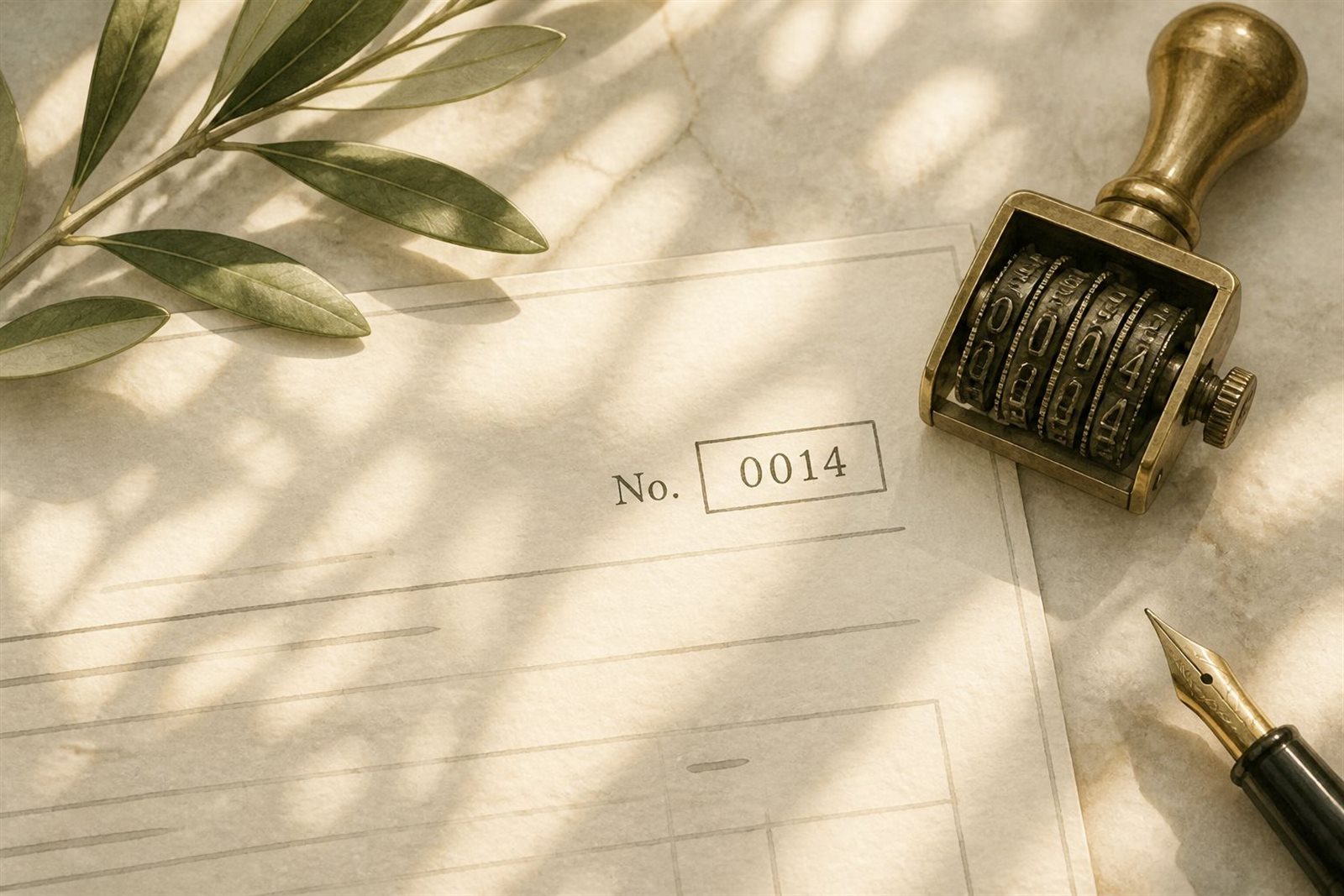
Use a plain running number, one higher each time: 0001, 0002, 0003. Add a prefix like INV- if you want it to look like an invoice number at a glance. Never reuse a number, and never skip around. That’s the whole system, and it’s enough for most freelancers.
If you’re staring at a blank invoice and wondering what number to put on the first one, “INV-0001” is fine. Nobody reads anything into it.
Why the number matters at all
An invoice number is how you and your client find the same document later. When a client writes “Can you resend invoice 0014?” or their accounts team asks which invoice a payment is for, the number is what everyone points at. It also lets you reply to a bank transfer with “that’s INV-0014” instead of describing the job.
It also keeps you honest with yourself. If your numbers run 0001 to 0030 with nothing missing, you can tell at a glance that nothing has gone astray.
A few formats that work
- Plain running numbers: 0001, 0002, 0003.
- A prefix plus a number: INV-0001, INV-0002.
- The year first: 2026-001 and 2026-002, then 2027-001 in January.
Pick one and stay with it. The year version is handy if you like a fresh start each January, but it’s a matter of taste, not a requirement. Say you’re a designer who sends about two invoices a month. INV-0001 will last you years without looking odd.
A word on looking established: some people start at 1000 so they don’t look like they have one client. It’s harmless. But your clients probably don’t count, and it’s not worth worrying about.
Don’t put client details in the number
Putting the client’s initials or the project name in the number (ACME-LOGO-01) feels organized for a week. Then you have three series to keep track of, and it’s easy to lose the thread. If you want to find all the invoices for one client, search by client name in your records. Keep the number itself boring.
What to do about gaps and mistakes
Say you sent INV-0012 with the wrong amount. You have two reasonable choices, depending on whether the client has seen it.
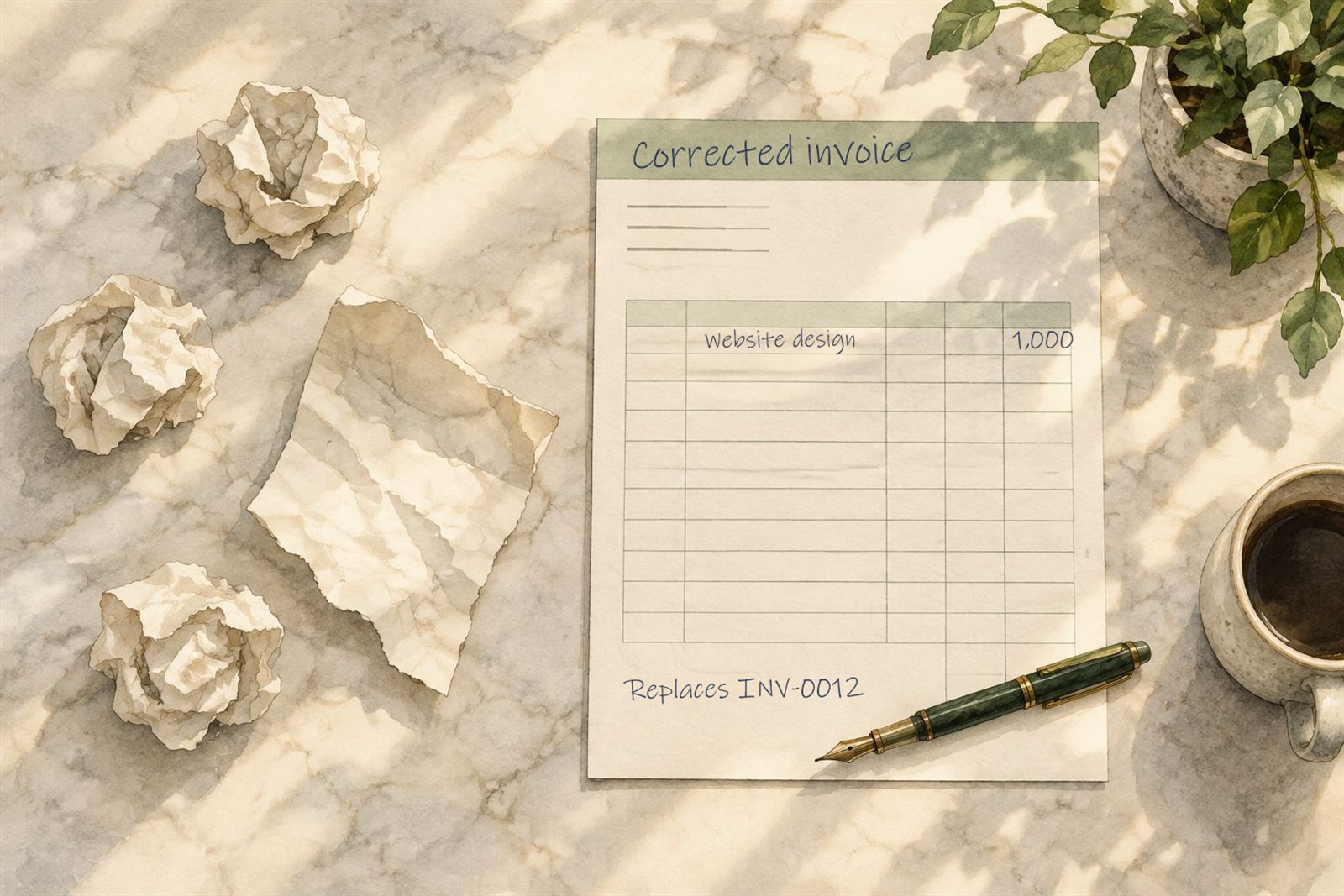
If it hasn’t left your hands, void or delete it, and either use the same number again or note that it was cancelled. If the client has already received it, don’t quietly change it and resend with the same number. That confuses everyone. Issue a corrected invoice with the next number (INV-0013) and tell the client in plain words that it replaces INV-0012. Keep INV-0012 in your records.
Where the law cares, it’s mostly the gaps that need explaining, not the fact that they exist. The UK tax authority’s guidance, for example, says a break in the sequence such as a cancelled or spoiled invoice is acceptable if you keep the invoice in your records or can explain it. So keep the cancelled one rather than throwing it away.
How a correction is formally handled (a credit note, a new invoice, or both) differs by country, so check yours if you’re VAT- or GST-registered.
When the tax rules get involved
If you’re registered for VAT, GST, or similar, the numbering is often not just a habit but a rule. The details depend on the country, so here are two examples, not a worldwide rule.
In the UK, HMRC’s guidance says a VAT invoice needs a sequential number based on one or more series that uniquely identifies the document. The number can be numbers or a mix of letters and numbers. You can start at a higher number than 1, and you can run more than one series (one per customer or per part of your business) as long as each one runs in order. The page was last updated on 16 January 2025.
In South Africa, the VAT Act asks for an “individual serialized number” and the date on a full tax invoice. We cover this in more detail in the post on tax invoice requirements in South Africa.
If you’re not VAT or GST registered, there may be no legal numbering rule on your invoices at all. But a clean running number is still the easiest thing to defend if anyone ever asks questions, and it costs you nothing. Rules vary a lot by country, so if you’re unsure, ask a local accountant or your tax authority. This is general guidance, not tax advice.
Let the software count for you
The most common numbering problem is simply losing track of what number you’re on, especially if you keep invoices in a folder and a spreadsheet. Wizard Invoice fills in the next number for you, using a prefix you set for each brand, so you don’t have to remember. You can also try the free invoice maker without an account if you just need one invoice today.
One last small habit: put the invoice number in the file name when you send a PDF, like INV-0042.pdf. It makes it easy to find later, for you and for your client.
Comments
No comments yet. Be the first to add one.