
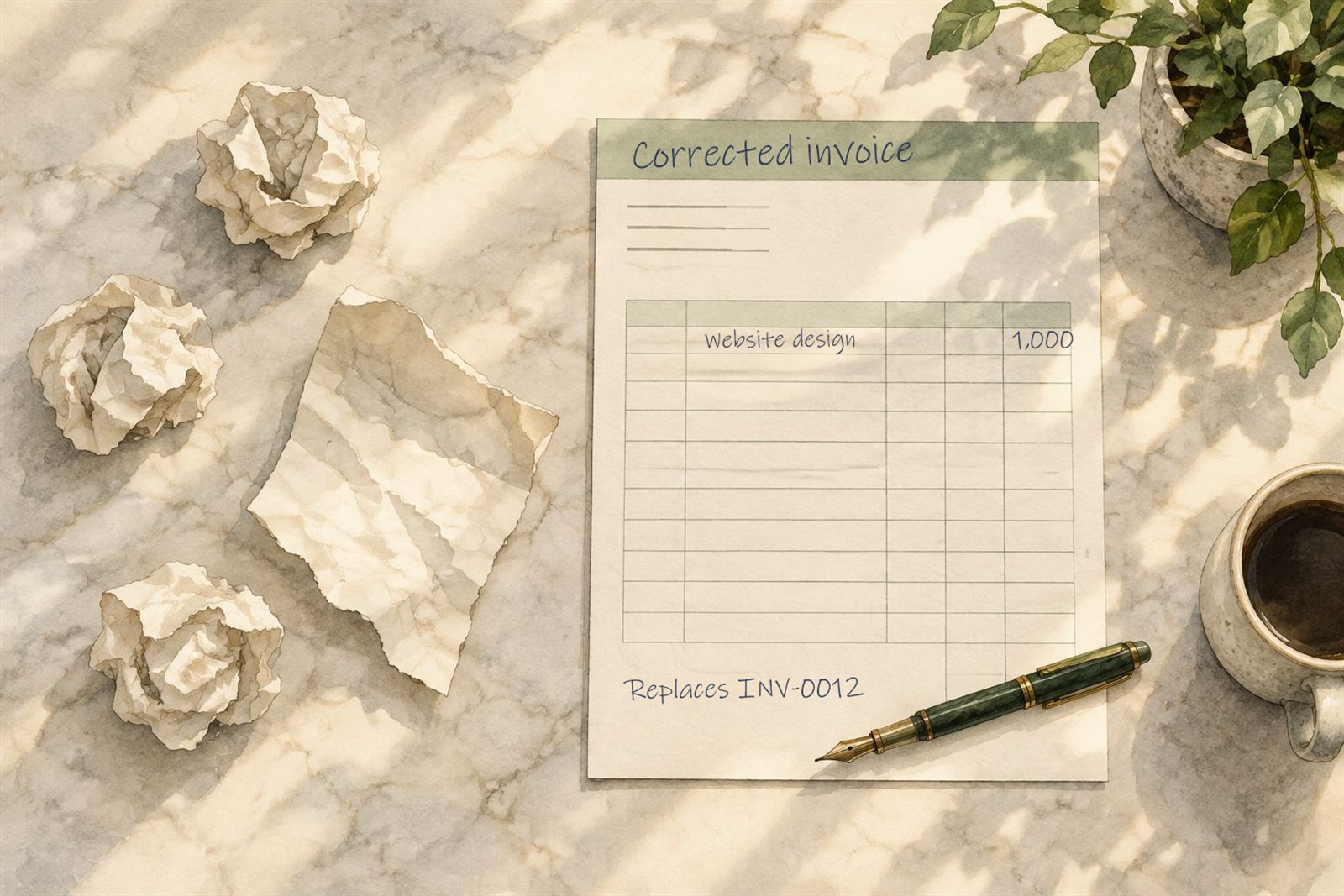
If the client hasn’t seen the invoice yet, just fix it. If they have, don’t quietly change it and send it again under the same number. Either send a corrected invoice that clearly replaces the old one, or send a credit note that cancels or reduces it. Which one you need depends on what went wrong, whether money has moved, and, if you’re registered for VAT or GST, your country’s rules.
That’s the short version. Here’s how to pick.
First, has it actually left your hands?
If the invoice is still a draft, or you created it but haven’t sent it, there’s nothing to correct. Edit it and move on. Nobody has a copy, so nobody’s records disagree with yours.
The same goes for the minute after you hit send, if you catch it fast and the client hasn’t opened it. Some people still prefer to treat it as sent, just to keep things clean. That’s a fair habit, but it’s a choice, not a rule.
What a credit note is
A credit note is a document you send to a client that reduces, or cancels, an invoice you already issued. It points back to the original invoice by its number and date, and says how much is being taken off and why.
Think of it as the opposite of an invoice. An invoice says "you owe me this". A credit note says "you owe me this much less", or "you owe me nothing on that one".
It exists for a practical reason. Once your client has an invoice, it may already be in their accounts. If you change your copy without telling them, the two sets of records no longer match. A credit note is the paper trail that brings them back together.
The names vary. In the UK and South Africa it’s a credit note. In Australia, for GST, the tax office calls the document an adjustment note. And if you undercharged rather than overcharged, the matching document is usually a supplementary invoice (the UK wording) or a debit note (the South African one).
Which fix fits which mistake
Here’s how most mistakes sort out, as general practice.
- The invoice wasn’t sent yet: edit it.
- It was sent, but the mistake doesn’t touch any money (a typo in their address, a missing purchase order number): send a corrected copy and tell the client in one line what changed. If you’re VAT- or GST-registered, check whether your country treats that as a new invoice.
- You charged too much: issue a credit note for the difference, or a credit note for the whole invoice and then a fresh, correct invoice with a new number.
- You charged too little: send an extra invoice (or debit note) for the difference that refers to the original, or credit the whole thing and reissue it.
- The job was cancelled: credit the whole invoice.
Credit-and-reissue is often the tidiest choice when lots of things are wrong. Your client gets one clean invoice to pay, and the old one is clearly cancelled rather than just abandoned.
An example
Say you’re a designer, and you sent INV-0012 to an example client, Harper and Lowe Studio, for 1,200. The agreed fee was 1,000. You typed the wrong figure.
If they haven’t paid, you could send a credit note for 200 that refers to INV-0012, so the balance due becomes 1,000. Or you could credit all 1,200 and send INV-0013 for 1,000. Either way, add a short note: "INV-0012 had the wrong amount. This credit note corrects it. Sorry for the mix-up." Keep INV-0012 in your records. Don’t delete it.
If the client already paid
This is where it gets a bit more real, because money has moved.
If they paid too much, you owe them the difference. Send the credit note, then either refund the amount or, if they agree, take it off their next invoice. HMRC in the UK describes a credit note as giving the customer a real entitlement to the overcharged amount, either as a refund or as an offset against future supplies. So agree which one with the client and write it on the credit note.
If they paid too little because you undercharged, send a separate invoice for the difference that points back to the original. Explain it plainly. Most clients would rather get a clear, polite "I undercharged you by 150, here’s the invoice for the difference" than find out later.
And if the mistake was in their details, not the amount, the payment is fine. Just send them the corrected copy for their records.
What the tax rules say in a few countries
If you’re not registered for VAT, GST or a similar tax, there may be no formal credit note rule for you at all. But the habit still helps, and tax offices still expect records. In the US, for example, the IRS lists invoices among the documents you should keep to show your income (page last reviewed 3 August 2026).
If you are registered, the rules are specific. Here are a few examples, not a worldwide rule.
United Kingdom. HMRC’s VAT Guide (Notice 700, last updated 25 June 2026) says a valid credit note must reflect a genuine mistake, overcharge or agreed reduction. It lists what the credit note must show, including its own number and date, your and your customer’s details, the amount credited and the VAT credited, and the number and date of the original VAT invoice. HMRC also says that if you charged too much VAT, you have to account for the higher amount unless you correct it with your customer by issuing a credit note. If you charged too little, you must account for the correct amount whether or not you correct it with the customer, for example with a supplementary invoice. A note that adjusts the price but not the VAT should say "This is not a credit note for VAT".
European Union. The EU VAT Directive (Article 219) treats any document that amends and refers specifically and unambiguously to the original invoice as an invoice itself. Each member state applies this in its own law, so check your country’s tax authority for the details.
Australia. For GST, the document is an adjustment note. The GST Act generally requires a supplier to issue one within 28 days of becoming aware of an adjustment, where a tax invoice was issued or asked for, or within 28 days of the client asking for one. Check the ATO’s page for the current wording.
South Africa. The VAT Act (section 21) says a supplier must issue a credit or debit note when the supply is cancelled, fundamentally changed, the price is altered, the goods or services are returned, or an error was made in the agreed price, and as a result a tax invoice shows the wrong amount of VAT. The credit note must show the words "credit note" prominently, your and your client’s details, the date, the amount of the reduction and the VAT, a brief explanation, and enough to identify the original transaction. We cover what goes on the original tax invoice in the post on tax invoice requirements in South Africa.
These rules change, and there are exceptions for particular trades. If you’re registered, check your tax authority’s page or ask a local accountant. This is general guidance, not tax advice.
Keeping your numbers straight
Many people give credit notes their own number series, separate from their invoices, so you might run CN-0001, CN-0002 alongside INV-0001 and so on. And a cancelled invoice keeps its number. You don’t reuse it. We go into gaps, prefixes and what to do with a cancelled number in how to number your invoices.
Doing it in Wizard Invoice
Wizard Invoice doesn’t have a separate credit note document. If you need a formal credit note for VAT or GST, make it with your accountant or in your accounting software.
For the corrected invoice itself, though, the Duplicate option saves retyping. It copies the original into a new draft with the next invoice number and today’s date. Fix the mistake, add a line in the notes such as "Replaces INV-0012", and send it. Keep the original in your records rather than deleting it. If you just need a single corrected invoice today, the free invoice maker works without an account.
One small habit that heads off most of this: read the total and the client’s name once more before you send. It takes five seconds. If you’re not sure whether you needed an invoice, a receipt or a quote in the first place, the post on the difference clears that up.

Comments
No comments yet. Be the first to add one.