
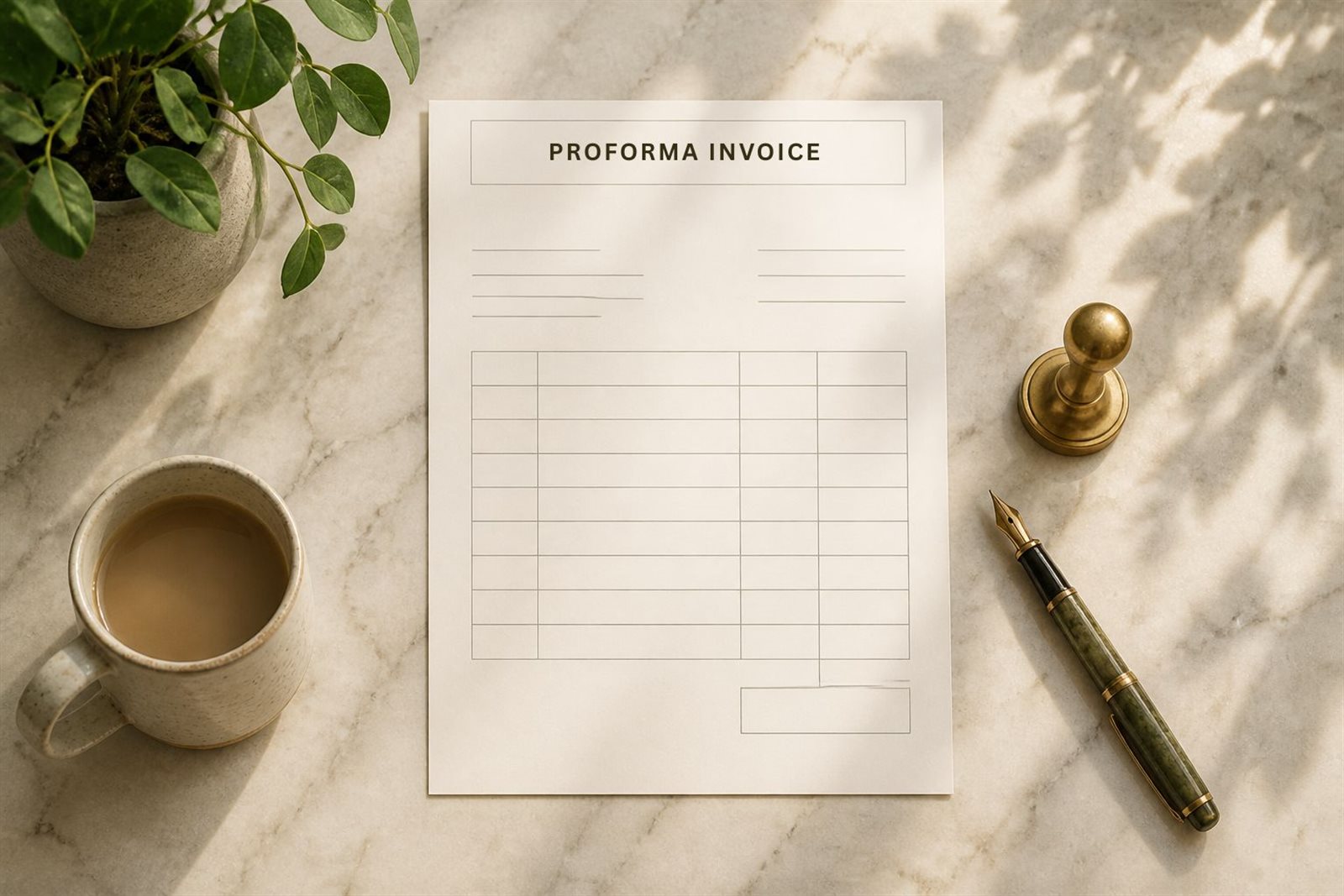
If you’re a freelancer, consultant, or small business owner, you’ll probably come across situations where a customer needs to pay before you start work or receive their order. But how do you request that payment professionally without issuing a final invoice too early?
That’s where a pro forma invoice comes in.
A pro forma invoice gives your customer a clear breakdown of what they’re expected to pay, what they’re paying for, and what happens next. It’s particularly useful when you need payment upfront, want to secure a project, or need to give a customer something they can use for internal approval.
Let’s look at how it works and when you should use one.
What is a pro forma invoice?
A pro forma invoice is an invoice-style document sent to a customer before goods or services are supplied. It outlines the expected costs and tells the customer how much they will need to pay.
Think of it as a preliminary payment document rather than a final invoice.
Although it looks similar to a standard invoice, there is an important distinction: a pro forma invoice is not a final sales invoice. In normal circumstances, it does not represent a completed sale or serve as the final accounting document for the transaction.
It should always be clearly labeled "PRO FORMA INVOICE" so there is no confusion between an estimated payment request and an official invoice.
What information should a pro forma invoice include?
A good pro forma invoice should give the customer everything they need to understand the proposed transaction and arrange payment.
Typically, it includes:
- Your business details: Business name, address, email address, and contact information.
- Customer details: The customer’s name, business name, and billing address.
- Document number: A unique reference number, preferably using a separate numbering sequence.
- Issue date: The date you prepared the document.
- Description of goods or services: A clear breakdown of what you’re providing.
- Quantities and prices: Individual costs, quantities, and subtotals where applicable.
- Taxes: Applicable taxes, such as VAT, where relevant, clearly identified.
- Total amount payable: The expected amount the customer needs to pay.
- Payment details: Bank account information, payment methods, and payment instructions.
- Payment terms: When payment is due and any conditions attached to it.
- Validity date: A deadline by which the customer should accept the offer, if applicable.
You can also include a short note explaining that work or delivery will begin once payment has been received.
When should you send a pro forma invoice?
A pro forma invoice is useful whenever a customer needs to know the expected cost before a transaction is completed.
Here are some common situations where it makes sense.
1. When you need payment in advance
If you require full payment before starting a project or delivering goods, a pro forma invoice gives your customer a clear payment request.
This is common among freelancers, designers, developers, consultants, and businesses selling made-to-order products.
2. When a customer needs budget approval
Some companies cannot release payments without internal approval. They may need a document showing the expected cost before they can authorize the purchase.
A pro forma invoice helps them present the expected expense to their finance or management team.
3. When a customer needs to raise a purchase order
Larger organizations often require a purchase order (PO) before confirming a purchase.
Your pro forma invoice provides the information they need to prepare that purchase order, including the description, quantities, and expected total.
4. When dealing with a new or higher-risk customer
If you’re working with someone for the first time or have concerns about payment reliability, requesting advance payment can reduce your financial risk.
A pro forma invoice makes the payment arrangement clear before you commit time, resources, or stock to the order.
A practical example: a freelance web developer
Imagine you’re a freelance web developer who has agreed to build a website for a new client.
The agreed project price is £2,000, and your payment terms require full payment before development begins.
Instead of immediately issuing a final invoice, you send the client a pro forma invoice showing:
- Website design and development: £2,000
- Total expected payment: £2,000
- Payment deadline: Within seven days
- Project start: Once payment has been received
The client uses this document to obtain internal approval and arranges the payment.
Once payment is received, you proceed with the project and issue the appropriate final invoice for the actual supply, following the applicable invoicing and tax rules.
This gives both parties a clear record of what was agreed and what happens next.
Pro forma invoice vs. quote vs. deposit invoice
These three documents can look similar, but they serve different purposes.
- Quote: Provides a proposed price for goods or services before the customer agrees to proceed.
- Pro forma invoice: Shows the expected amount payable and is commonly used to request advance payment.
- Deposit invoice: Requests a specific deposit or part-payment towards an agreed purchase or project.
For example, a quote might tell a client that a project will cost £2,000. Once they accept, you could send a pro forma invoice requesting the full amount upfront.
Alternatively, you could request a 50% deposit using an appropriate deposit invoice or payment request.
The important thing is to use the document that accurately reflects the transaction and your payment arrangement.
What should you do after receiving payment?
Once the customer pays, don’t simply leave the pro forma invoice as the only record of the transaction.
You should issue the proper invoice for the actual goods or services supplied, in accordance with the applicable accounting and tax requirements.
Make sure the final invoice:
- Has its own appropriate invoice number.
- Reflects the actual goods or services supplied.
- Shows the correct amount and any applicable taxes.
- Records the payment received, where appropriate.
- Clearly identifies any outstanding balance, if there is one.
Keep the pro forma invoice and final invoice together in your business records. This makes it easier to track payments and avoid confusion or duplicate accounting entries.
UK VAT considerations
If your business is VAT-registered in the UK, there is an important distinction to understand.
A pro forma invoice is not a VAT invoice. Even if it includes a VAT breakdown and your VAT registration number, the customer cannot generally use it to reclaim input VAT.
HMRC specifically states that pro forma invoices cannot be used as evidence for reclaiming input tax. They should also be clearly marked "This is not a VAT invoice."
When payment is received or the goods or services are supplied, you may need to issue a proper VAT invoice. For relevant taxable supplies, HMRC generally requires a VAT invoice within 30 days, subject to the applicable rules and exceptions.
VAT-registered businesses should make sure they issue the correct VAT documentation and account for VAT at the appropriate time.
Remember that VAT rules differ between countries. If you operate outside the UK or deal with international customers, check the tax and invoicing requirements that apply to your jurisdiction.
Practical tips for using pro forma invoices
A few simple practices can make managing pro forma invoices much easier:
- Use a separate numbering system: For example, PF-0001, PF-0002, and PF-0003. This helps distinguish preliminary documents from final sales invoices.
- Label it clearly: Put "PRO FORMA INVOICE" prominently at the top.
- Set clear payment terms: State whether full payment or a deposit is required.
- Explain when work begins: Include a note such as "Work will commence once payment has been received."
- Add a validity date: If prices or availability may change, specify how long the offer remains valid.
- Keep proper records: Store the pro forma invoice alongside the corresponding payment and final invoice.
Pro forma invoice checklist
Before sending one to a customer, check the following:
- Clearly labeled "Pro forma invoice."
- Correct business and customer details.
- Unique document reference number.
- Accurate description of goods or services.
- Correct prices, quantities, and total amount.
- Applicable taxes are clearly identified.
- Payment instructions and payment deadline included.
- Validity date added, where appropriate.
- Clear statement explaining when work or delivery begins.
- Not presented as a final invoice or VAT invoice.
Final thoughts
A pro forma invoice is a simple but useful tool for managing payments before completing a sale or delivering a service.
For freelancers and small businesses, it helps establish clear expectations, request advance payments, and make the payment process more professional.
The key is understanding what it does and what it doesn’t do. Use it to communicate expected costs and request payment, then issue the appropriate final invoice when required.
A little clarity before a transaction can save a lot of confusion afterwards.

Comments
No comments yet. Be the first to add one.